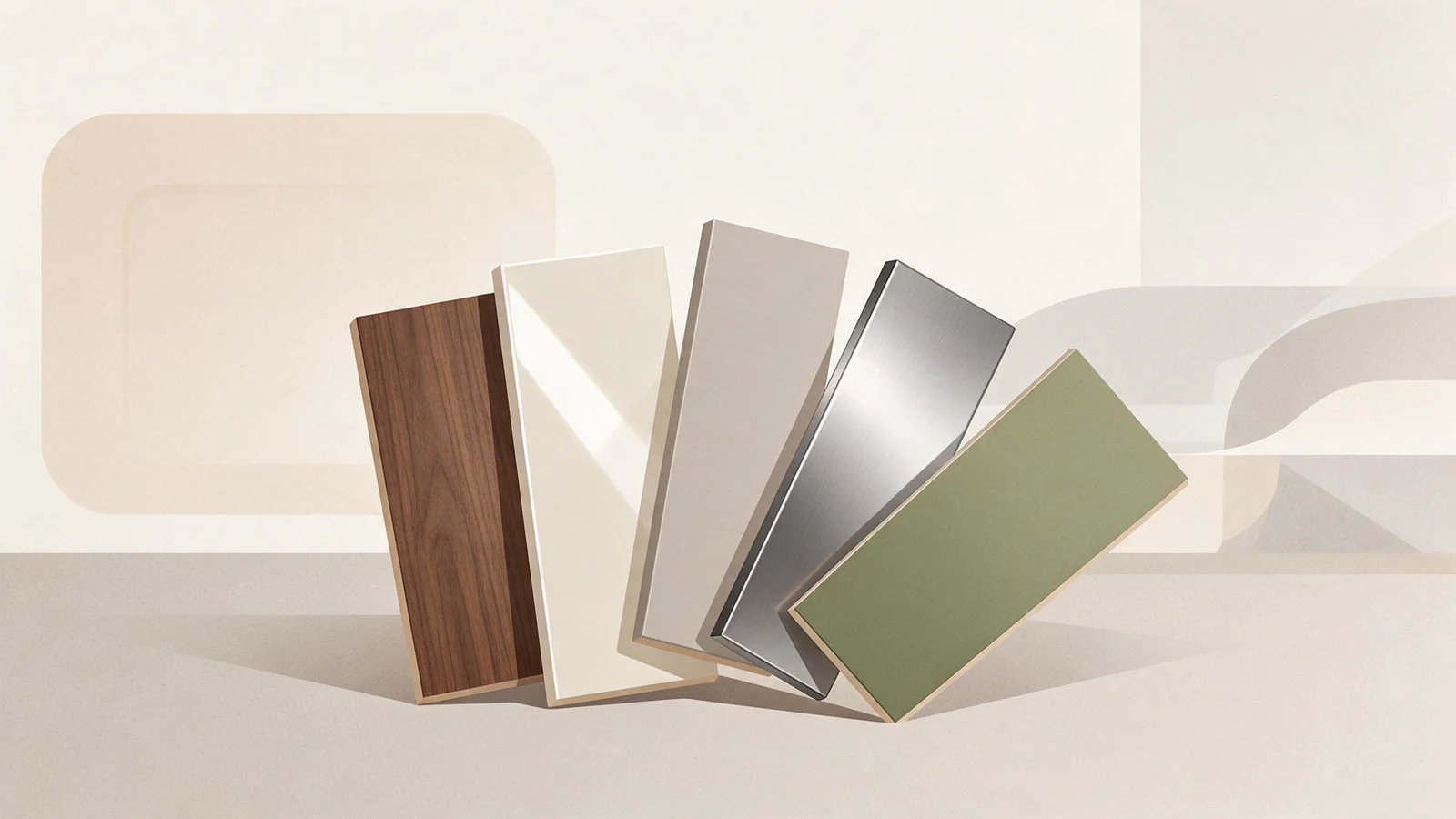
Most buying decisions on kitchen cabinets come down to two questions. What is the cabinet body made of, and what finish sits on the door? Get those two answers right and the rest of the specification usually falls into place. This guide walks through the material families Winway produces and exports, the trade-offs between them, and the points worth writing into a purchase order.
Winway has been established in Foshan since 1997 and works with importers, wholesalers, contractors and project buyers. Kitchen cabinets sit alongside wardrobes and whole house customization in the range, and the same workshop and supply chain that handles semi-customized, non-standard items also handles cabinet components.
Why the material choice decides the whole order
A cabinet is a box with a door on it. The box has to stay square, hold a countertop, survive humidity and take hinges and drawer runners without splitting. The door has to look right for years and clean up without clouding.
Materials drive all of that. They also drive freight weight, packing method and how much of a container you can fill. A buyer who chooses a heavy solid wood door for a coastal apartment block and a buyer who chooses a lacquered MDF door for the same block will ship different weights, pack differently and get different site feedback two years later.
There is no single best material for kitchen cabinets. There is a best material for a given climate, budget band and project type. The sections below set out what each family does well.
Cabinet body materials: MDF vs plywood cabinets
The carcass, meaning the sides, base, shelves and back, is usually built from an engineered panel. Two families dominate export orders.
MDF cabinets
MDF is a dense, uniform panel made from wood fibre. Because it has no grain direction and no voids, it machines cleanly and holds a routed profile or a sprayed finish very evenly. That makes it the natural partner for painted and lacquered doors, and for any design where the door face is meant to read as one flat colour.
Winway lists MDF kitchen cabinets and MDF shaker cabinets in the range, alongside high gloss MDF and lacquered MDF variants. For apartment and hotel work where a consistent, flat, easy-clean face matters more than visible timber grain, MDF is usually the practical starting point.
Plywood cabinets
Plywood is built from thin veneers glued in alternating directions. The cross-grain construction gives it good screw-holding along the edges and makes it more tolerant of moisture movement than a homogeneous fibre panel. Buyers who expect cabinets to be installed in a humid kitchen, or who want the carcass to take repeated on-site adjustment, often ask for plywood.
Bamboo plywood kitchen cabinets also appear in the Winway range, where the panel itself becomes part of the visible design story rather than a hidden substrate.
How to choose between them
Ask three questions. Will the door be painted or lacquered? If yes, MDF is the easier substrate. Is the kitchen in a humid or coastal building? If yes, plywood deserves a closer look. Does the buyer care about the carcass being visible or specified by name? If yes, plywood is easier to defend in a tender document.
In practice many export orders mix the two: plywood or a moisture-tolerant panel for the carcass, MDF for the door face. That combination is common because each material is doing the job it is good at.
Door finishes: lacquer vs PVC kitchen cabinets
The finish is what the end user sees and touches every day. It also decides how the cabinet ages in a working kitchen.
Lacquer kitchen cabinets
Lacquer is a sprayed coating, built up in layers and usually polished to a chosen sheen. It gives the deepest colour control of any finish, which is why lacquer kitchen cabinets are common in hotel and villa work where the joinery has to match a designer palette. High gloss lacquer, white lacquer and water-based lacquer options all sit in the Winway range.
The trade-off is process. A lacquered door takes more production steps than a laminated one, so it rewards a buyer who has approved a sample and then holds the specification steady.
PVC kitchen cabinets
PVC is a film bonded to the door panel. It delivers a consistent surface, resists everyday moisture and cleaning, and is straightforward to specify across a large number of identical units. Laminated PVC and white PVC kitchen cabinets are both listed, and PVC cabinets for outdoor kitchen use are also available where the door has to cope with a covered outdoor position.
For a rental apartment block or a mid-range hotel with hundreds of identical kitchens, PVC is often the finish that keeps the order simple. For a villa where the client has chosen a specific colour, lacquer gives more room to match it.
Other finishes worth knowing
Acrylic kitchen cabinets use a high gloss acrylic face that reads as a deep, mirror-like colour. Glass kitchen cabinets and frosted glass kitchen cabinet options put a glass panel on the door front. Metal kitchen cabinet, stainless steel kitchen cabinets and stainless steel commercial kitchen cabinets cover the working kitchen end of the range, including outdoor kitchen cabinets.
Timber species and the look of the door
When the door is meant to show grain, the species does the talking. Winway produces solid wood kitchen cabinets and a range of veneer-led designs: walnut kitchen cabinets in modern, dark, light and antique tones; oak kitchen cabinets including solid oak, dark oak and light oak; ash kitchen cabinets in natural, grey and white ash; plus maple, cherry and pine options.
Species choice is mostly a design decision, but it has a practical edge. Open-grain timbers show a working kitchen's marks more readily than a closed, uniform surface. In a busy commercial kitchen, that is worth weighing against the look the designer wants.
Comparing the main options
| Option | Typical use | What it does well | What to watch |
|---|---|---|---|
| MDF carcass | Painted or lacquered doors, apartment and hotel units | Flat, uniform face; clean machining | Keep edges sealed in humid rooms |
| Plywood carcass | Humid or coastal kitchens, heavy use | Edge screw-holding; moisture tolerance | Panel quality varies by supplier |
| Lacquer door | Villas, hotels, colour-matched joinery | Widest colour control; deep sheen | More production steps; hold the approved sample |
| PVC door | Rental apartments, repeat unit orders | Consistent surface; easy cleaning | Less colour freedom than lacquer |
| Solid wood or veneer door | Feature kitchens, villa joinery | Visible grain and warmth | Open grain shows marks sooner |
The table is a starting point, not a rule. Two projects with the same budget can land on different rows because of climate, cleaning routine or how the client wants the kitchen to feel.
What to put in your specification
A materials guide is only useful if it turns into a document a supplier can quote against. Send drawings or a product list with the carcass material, the door finish, the colour reference and the hardware expectation. Winway's team prepares 2-3 design options for approval once plans and specifications are in hand, and quotes are returned within 24 hours.
Custom orders are supported, including kitchen cabinet layouts, finishes and private labelling. Custom work typically carries a higher minimum order quantity and includes a pre-production sample approval step before full manufacturing begins. Samples are free of charge; the buyer pays international shipping.
On delivery, Winway supports FOB Foshan or Guangzhou, CIF and EXW, with door-to-door service available for some countries. Cabinets can be consolidated with other categories into one shipment. Architects can be sent to guide installation on site, or a construction team can carry out the work.
If you are still mapping the wider joinery package, the custom cabinets page shows how a single specification can cover several rooms, and the about page covers how Winway works with project buyers.
Common mistakes in cabinet material selection
The first is choosing a finish from a photograph. Colour and sheen read differently under a factory light and under a hotel corridor light, which is why the sample approval step exists.
The second is specifying a heavy door for a project where freight weight matters more than the door itself. Weight affects packing, loading and cost, and it is easier to settle before the order than after.
The third is leaving the carcass material unstated. If the purchase order says only the door finish, the carcass becomes an assumption, and assumptions are where disputes start.
Write down the carcass, the door, the colour and the hardware. Then order a sample, check it against the drawing, and keep that approved sample as the reference for the whole run.